Christopher Nolan’s The Odyssey brings Homer’s ancient epic to the big screen on an enormous scale, but you don’t have to be satisfied with seeing its spectacular landscapes on a cinema screen. Many of the movie’s filming locations are real places that travelers can visit.
Filmed across Greece, Italy, Morocco, Iceland, Scotland and Malta, The Odyssey takes audiences from ancient fortresses and Mediterranean islands to windswept beaches, volcanic landscapes and rugged northern coastlines.
For travelers fascinated by movie locations, the film provides the perfect excuse for an unusual journey through some of Europe’s and North Africa’s most dramatic scenery.
From Favignana in Sicily, which stood in for Ithaca, to Morocco’s Aït Benhaddou, which represented Troy, here are some of the most spectacular The Odyssey filming locations you can visit.
Where Was The Odyssey Filmed?
Christopher Nolan filmed The Odyssey on location in six countries: Morocco, Greece, Italy, Iceland, Scotland and Malta. Principal photography took place in 2025 over 91 days, with Nolan making extensive use of real landscapes rather than relying entirely on computer-generated environments.
The result is a film with an unusually broad geographical footprint.
Some locations represent places from Homer’s epic, while others were chosen because their landscapes could convincingly recreate the mythical world of Odysseus.
Here are some of the locations you can visit.
1. Favignana, Sicily, Italy — Ithaca
One of the most exciting destinations for fans of The Odyssey is Favignana, a beautiful island in Sicily’s Aegadian Islands.

Santa Caterina castle, Favignana Island in Sicily, Italy (Shutterstock)
For the film, Favignana stood in for Ithaca, the home of Odysseus.
The production used the island’s rugged coastline and historic architecture to create the world of Odysseus and Penelope. Castello di Santa Caterina, a fortress high above Favignana, was used as Odysseus’s palace.
The location is particularly spectacular because the castle sits on Monte Santa Caterina with expansive views across the surrounding Mediterranean.
Why visit Favignana?
Even without its connection to The Odyssey, Favignana is an appealing destination for travelers who enjoy beaches, clear water, cycling and Mediterranean island scenery.
The island can therefore be experienced as both a movie destination and a relaxing Sicilian escape.
2. Voidokilia Beach, Greece — The Cyclops
Greece naturally plays an important role in a movie based on Homer’s epic.

Nestor’s Cave in the Peloponnese (Shutterstock)
One of the most spectacular filming locations is Voidokilia Beach in Messenia, on Greece’s Peloponnese peninsula.
The distinctive crescent-shaped beach was used for a shipwreck sequence, while nearby Nestor’s Cave was used for scenes involving the Cyclops Polyphemus.
Voidokilia is already famous for its unusual shape and turquoise waters, making it one of the most beautiful beaches in the Peloponnese.
For travelers, this is perhaps one of the easiest locations to combine with a conventional Greek holiday.
Visiting Voidokilia Beach
Voidokilia is located in the Messenia region, within reach of Kalamata International Airport.
The beach is particularly attractive during the warmer months, although visitors should check local conditions and access information before traveling.
3. Methoni Castle, Greece — The World of Kings
Another spectacular Greek filming location is Methoni Castle, a medieval fortress on the southwestern tip of the Peloponnese.
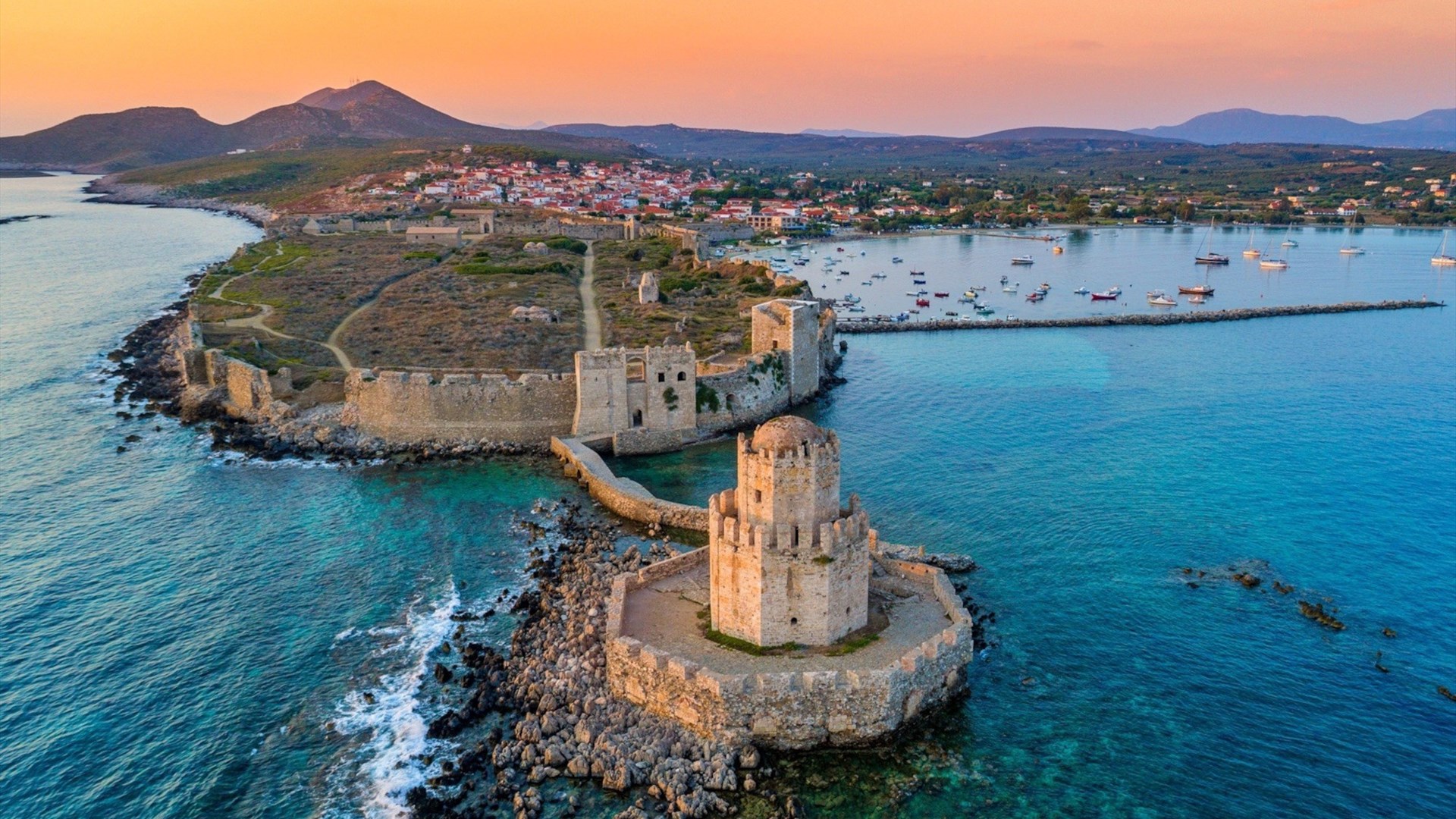
The castle was used for scenes representing the world of the ancient Greek kings, including the palace of Menelaus and Helen.
Although the real fortress is medieval rather than ancient Greek, its enormous stone walls, towers and position beside the sea provide exactly the kind of dramatic setting required for Nolan’s epic.
The castle is open to visitors and makes an excellent addition to a road trip through southern Greece.
4. Acrocorinth, Greece — An Ancient Fortress
High above the ancient city of Corinth stands Acrocorinth, one of Greece’s most impressive fortified sites.
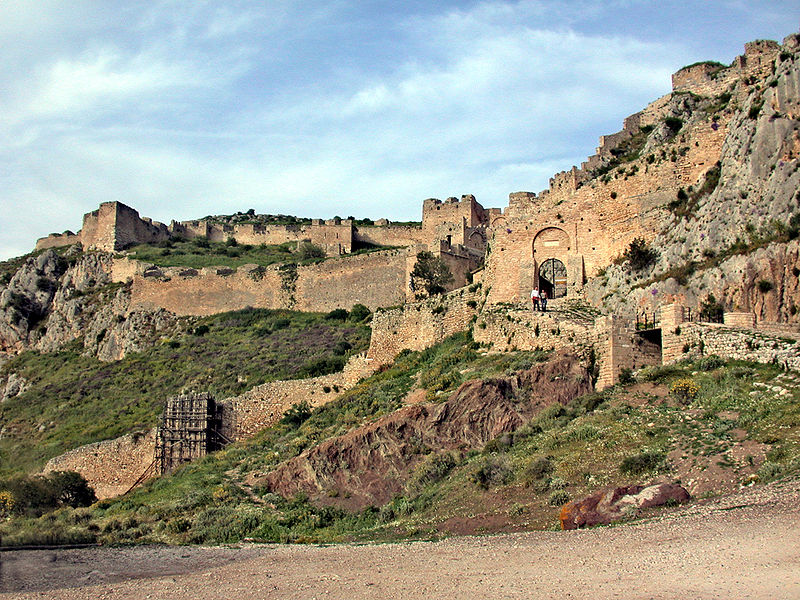
The enormous fortress was another Greek location used during production of The Odyssey. It was used to represent Agamemnon’s palace in the film and was also used in the scene where Agamemnon was seen arriving at his monumental palace gates after the Trojan War.
The location is especially worthwhile for travelers interested in ancient history.
From the summit, visitors can enjoy extensive views across the surrounding landscape and the Gulf of Corinth.
It is a place where the real history of Greece and Nolan’s fictional interpretation of the ancient world come together.
See: Ancient Corinth – Acrocorinth & Corinth Canal Private Half-Day Trip from Athens
5. Aït Benhaddou, Morocco — Troy
One of the most recognizable locations in The Odyssey is Aït Benhaddou in Morocco.

Aït Benhaddou is a fortified town in Ouarzazate province, Morocco. (Shutterstock)
The spectacular fortified village, or ksar, was used to represent Troy.
The climax of the opening sequence featured Odysseus and the Greek army rushing through the burning entrances and narrow, winding alleyways at night, utilizing controlled flames to capture the chaotic fallback and total destruction of the city.
With its earthen buildings, towers and dramatic desert surroundings, Aït Benhaddou already looks like something from an ancient epic. It has also appeared in numerous other major films and television productions, including Lawrence of Arabia, Gladiator and The Mummy.
For travelers, visiting Aït Benhaddou is like stepping onto an enormous movie set—except that this is a genuine historic settlement.
See: Full Day Trip to Ouarzazate and Ait Benhaddou from Marrakech
How to visit Aït Benhaddou
Aït Benhaddou is located in southern Morocco and is commonly visited as part of a trip between Marrakech and Ouarzazate.
Allow plenty of time to explore the village rather than simply stopping for a photograph. The surrounding landscape is an important part of its appeal.
6. Essaouira, Morocco — The Trojan Coast
The Moroccan filming wasn’t limited to Aït Benhaddou.
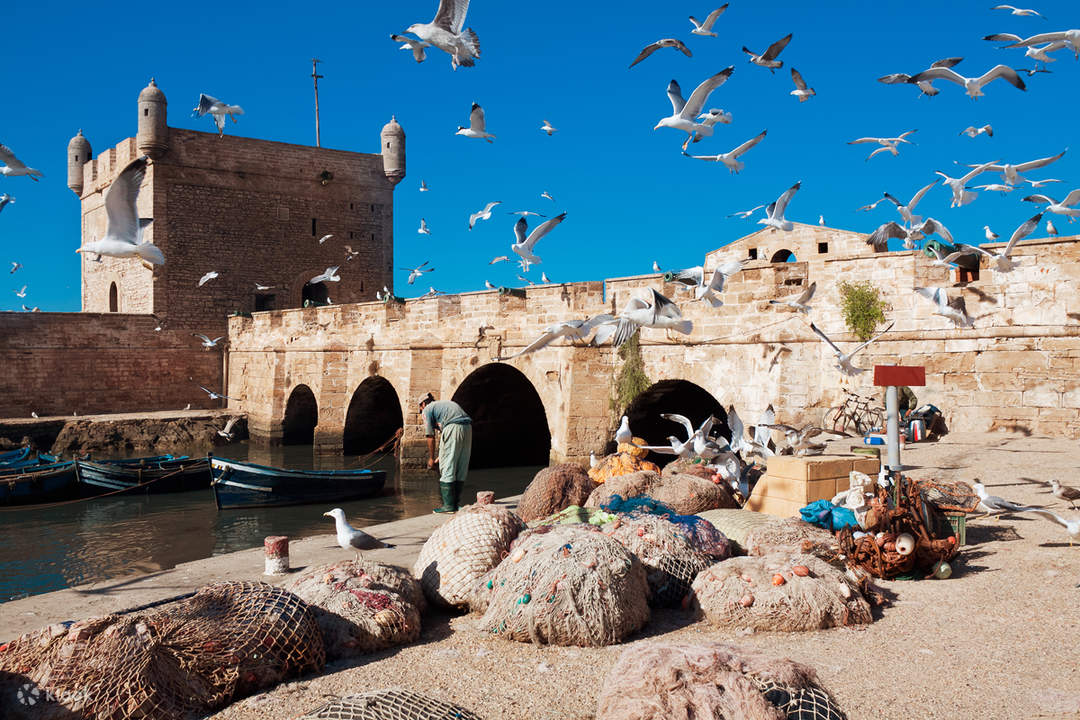
Scenes were also filmed around Essaouira, the atmospheric coastal city on Morocco’s Atlantic coast. Production used the area for scenes connected with Troy and the Trojan coast.
The historic harbor and the Skala du Port were featured in the sequence where Odysseus and his army finally set sail to start their long journey back to Ithaca after the fall of Troy.
Essaouira makes an excellent contrast to the desert landscapes of southern Morocco.
Its historic medina, fishing harbour, sea walls and Atlantic beaches provide plenty to explore after discovering the movie locations.
See: Essaouira & Sekkala Day Trip with Optional Lunch from Marrakech
7. Aeolian Islands, Sicily — The Island of Aeolia
Italy provided another major part of the film’s Mediterranean landscapes.

The production filmed around the Aeolian Islands, including Lipari, Basiluzzo and Vulcano, for scenes associated with the mythical island of Aeolia where Odysseus’ crew members navigated the treacherous waters around the Charybdis (whirlpool), the Scylla (the six-headed monster) and the Siren’s island.
This is one of the most appealing destinations for travelers who want to combine movie tourism with an island holiday.
The Aeolian Islands are famous for volcanic landscapes, dramatic coastlines and clear Mediterranean waters.
Visit the Aeolian Islands
The islands are scattered off Sicily’s northern coast and are connected by ferries.
Rather than attempting to visit them as a quick day trip, consider spending several nights in the archipelago and using one island as a base for exploring others.
8. Iceland — The Darker Side of Odysseus’s Journey
The Odyssey’s world isn’t entirely Mediterranean.

Production also travelled to Iceland, where the country’s stark volcanic landscapes were used to create some of the film’s more otherworldly environments.
One reported location is Hjörleifshöfði, a dramatic headland on Iceland’s south coast.
The haunting scene where Odysseus descends into the Underworld (Hades) to meet with the shades of the dead—including Agamemnon (Benny Safdie) and Tiresia, was filmed on the black volcanic sands of Hjörleifshöfði.
The landscape could hardly be more different from the sunny islands of Greece and Sicily, but provided the required contrast which helped illustrate the bleak and otherworldly look and feel of the scene.
For travelers, Iceland’s combination of black-sand beaches, glaciers, volcanoes and enormous open landscapes makes it an extraordinary destination in its own right.
9. Scotland — The Moray Coast
Scotland also features in the film’s production.

The ruins of Findlater Castle (Shutterstock)
Filming took place around the Moray Firth, including locations such as Findlater Castle, Culbin Forest and Burghead.
The witch, Circe‘s eerie, isolated stronghold was brought to life at the dramatic, 13th-century cliffside ruins of Findlater Castle along the Moray Firth coast in Scotland. The crumbling stone fort perched high above the crashing, grey waves of the North Sea perfectly mirrors the bleak, unsettling tone of her character’s domain.
The rugged Scottish coastline provided another dramatic landscape that fits naturally into the mythological world where Odysseus’ desperate and starving men unknowingly played into the witch’s hand and were turned into pigs.
Findlater Castle, in particular, is an atmospheric ruin perched dramatically above the North Sea.
For travelers who enjoy combining film locations with hiking and historic sites, this part of Scotland could make an excellent addition to a longer Scottish itinerary.
10. Malta and Gozo
Malta also formed part of the production.
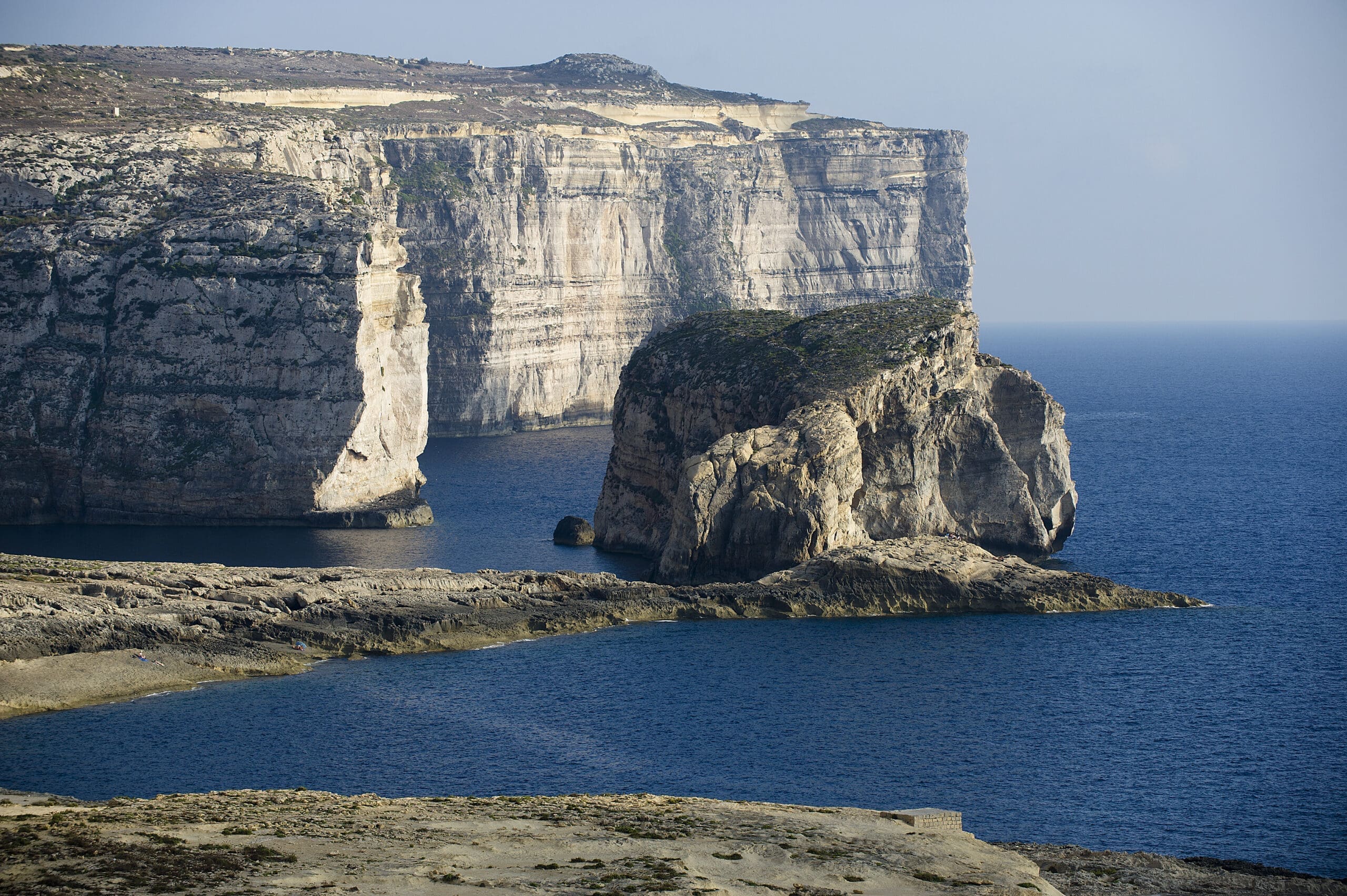
The island’s dramatic coastline and Mediterranean landscapes were used for the film, while Gozo provided locations associated with the mythical world of Odysseus.
Among the locations reported is Dwejra Bay, one of Gozo’s most spectacular coastal areas.
The rugged, windswept clifftops provided the dramatic visual framing for the emotional core of this sequence—where a weary, stranded Odysseus (Matt Damon) sits right on the edge of the world, staring hopelessly out across the vast, open Mediterranean Sea as he weeps for his home and family in Ithaca.
The area is already famous for its dramatic rock formations and has a long association with film and television productions.
Can You Follow The Odyssey’s Entire Journey?
Not exactly.
One of the fascinating things about The Odyssey is that the movie’s locations are not necessarily the same places described in Homer’s original story.
Homer’s geography is partly mythical, and the locations traditionally associated with Odysseus’s adventures have been debated for centuries.
Nolan therefore used real landscapes from several countries to recreate the atmosphere of the epic rather than attempting to reproduce a literal geographical route.
That means a modern Odyssey road trip is best thought of as a journey inspired by the film rather than an exact recreation of Odysseus’s voyage.
How to Plan Your Own Odyssey Movie Tour
Trying to visit every filming location in one trip would involve several countries and a considerable amount of travel.
A better approach is to divide the locations into regional trips.
Greece
Visit:
- Voidokilia Beach
- Nestor’s Cave
- Methoni Castle
- Acrocorinth
- Pylos
This would make an excellent Peloponnese road trip.
Sicily
Visit:
- Favignana
- Lipari
- Vulcano
- Basiluzzo
This creates a spectacular Sicily and Aeolian Islands itinerary.
Morocco
Visit:
- Aït Benhaddou
- Essaouira
- Marrakech
This could become a Morocco film-location adventure.
Scotland
Visit:
- Findlater Castle
- Burghead
- Culbin Forest
- the Moray coast
Iceland
Build the film locations into a wider Iceland road trip rather than visiting them as isolated attractions.
Best The Odyssey Filming Location for Travelers
If you can visit only one location, Favignana in Sicily may be one of the most rewarding choices.
It combines a direct connection to the film with beautiful Mediterranean scenery, beaches, historic architecture and a relaxed island atmosphere.
For history lovers, however, the Greek locations around Messenia and Corinth may be more compelling.
And if you want the most visually dramatic movie location, Aït Benhaddou in Morocco is not to be missed.
Final Thoughts
You don’t have to follow Odysseus’s mythical ten-year journey to experience the movie’s locations. Instead, choose one region and turn it into your own cinematic adventure.
From the islands of Sicily to the ancient landscapes of Greece and the dramatic coastlines of Morocco, The Odyssey offers travelers a remarkable new reason to explore some of the world’s most extraordinary destinations.