Penang’s Gourmet Soul
There are cities you taste before you see. Penang is one of them—an island where clove and cinnamon ride the sea breeze, where the clang of a wok is as steady as the tide, and where dinner can be a lesson in history if you listen closely. I came for “street food,” and left convinced that Penang is Asia’s most elegant argument for culinary luxury: not diamonds on a plate, but lineage, technique, and time—edited and presented with poise.
Try a new assembly of spices and you can map a whole world. In George Town, recipes remember the spice ships that once threaded the Malacca Strait: star anise and lemongrass, nutmeg and torch ginger, bird’s eye chilli and tamarind. What makes the island irresistible to a luxury palate is the restraint—layered flavours that never shout, acidity that lifts rather than bites, heat that hums instead of burns. Pair that with the city’s heritage mansions and shophouses and you have the rarest thing: tasting menus that still feel human.
You’ll hear people call Penang “the world’s street food capital.” True. But look again and you’ll find a parallel stage emerging: chefs curating private salons in restored townhouses; heritage hotels serving deconstructed hawker icons with cellar-level wine programs; quiet, invitation-only suppers that treat ancestral recipes with white-glove respect. The thrill is not in gilding char kway teow—it’s in respecting char, smoke, and noodle bounce so thoroughly that you don’t dare look away while you eat it.
A Short Lineage, Distilled. Penang’s culinary identity took shape after 1786, when the island became a British port and a magnet for Hokkien Chinese, Malay, Indian, and Thai communities. Intermarriage birthed Peranakan (Nyonya) cuisine—Chinese technique woven with Malay herbs—while the maritime spice trade broadened the pantry. Today, that fusion reads as a precise grammar of sweet-sour-spicy-savoury.
See: Baba Nyonya Costume Rental Experience
How the Tradition Lives On—And Ascends. Grandmothers and hawkers safeguard the soul in George Town’s lanes, while contemporary chefs refine it. In Singapore, Peranakan cuisine now sits comfortably in fine-dining rooms—think precise rempah, premium seafood, sculpted plating—proving the form’s elegance without abandoning its memory. Heritage becomes haute not by excess, but by meticulous attention.
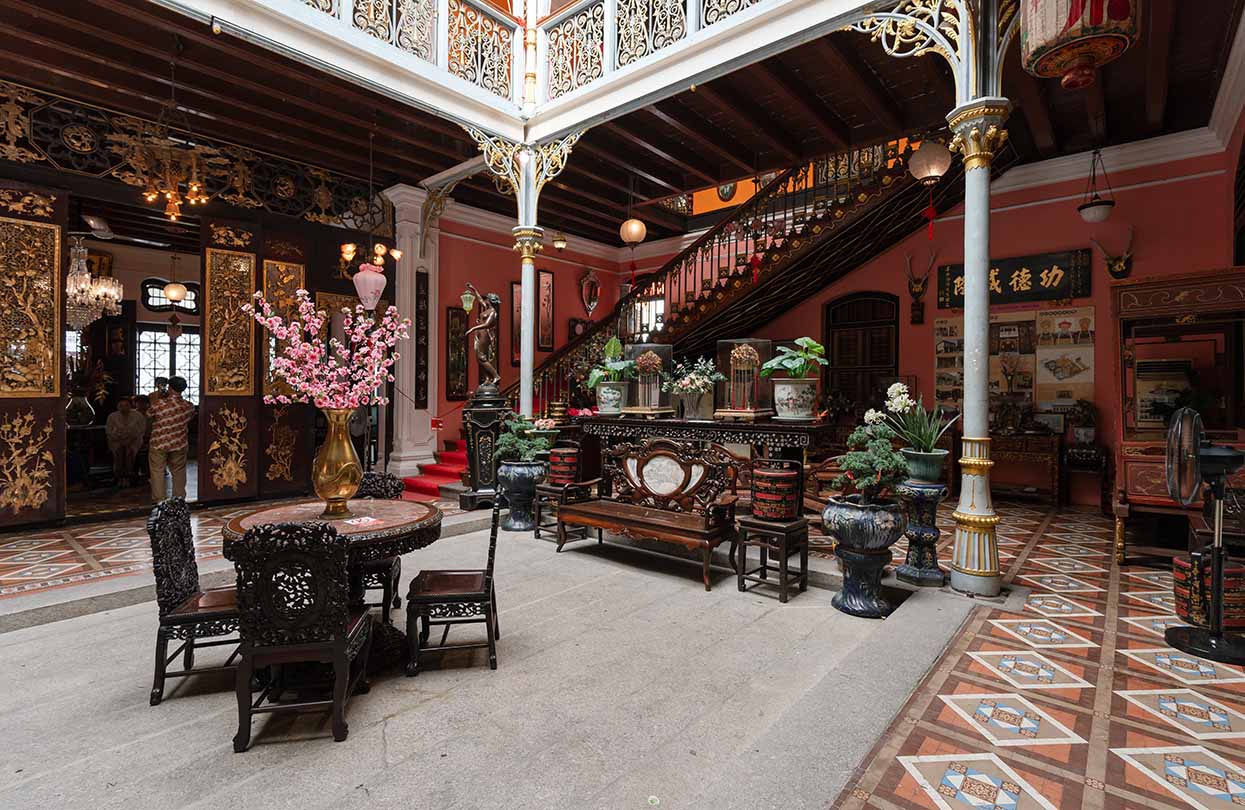
Peranakan Mansion interior, image by umitc, shutterstock
Where to Begin: A Palate Primer for the Luxurious
Assam Laksa, Elevated. Penang’s emblematic noodle soup balances tamarind tang with mackerel depth, mint brightness with torch ginger perfume. In a white-tablecloth setting, the broth lands clarified rather than cloudy, punctuated by line-caught fish, julienned cucumber, pineapple, and the quiet swagger of hae ko (shrimp paste) used sparingly. Pair with a dry Riesling; watch the citrus oils and galangal find each other mid-palate.
Nasi Kandar, Reimagined. Born of Indian-Muslim traders, this “rice plus many curries” becomes a measured composition when plated for a small dining room. Think aged basmati fluffed to a cloud, sauces drawn in precise arcs: black pepper gravy, turmeric-forward fish curry, a star anise lamb jus with gloss you could almost see your reflection in. It’s still messy—in the best sense—but the mess is choreographed.
Otak-Otak, Unwrapped with Ceremony. The banana leaf opens to a custard that trembles like silk: local fish, coconut milk, turmeric, chilli, and daun kaduk. Fire-kissed edges speak of charcoal; the center stays barely set. I’ve watched chefs finish it with a thread of coconut cream and a whisper of calamansi. Luxury is heat control measured to the second.
Char Kway Teow, With Provenance. For purists, this belongs curbside. For collectors of craft, a chef’s counter with a single wok and sustainably sourced prawns tells the same story—just at closer range. Smoke (that elusive wok hei) is the currency; timing is the language. You’ll taste cockles like briney punctuation, chives like an aside, and see why “seconds too long” is a tragedy.
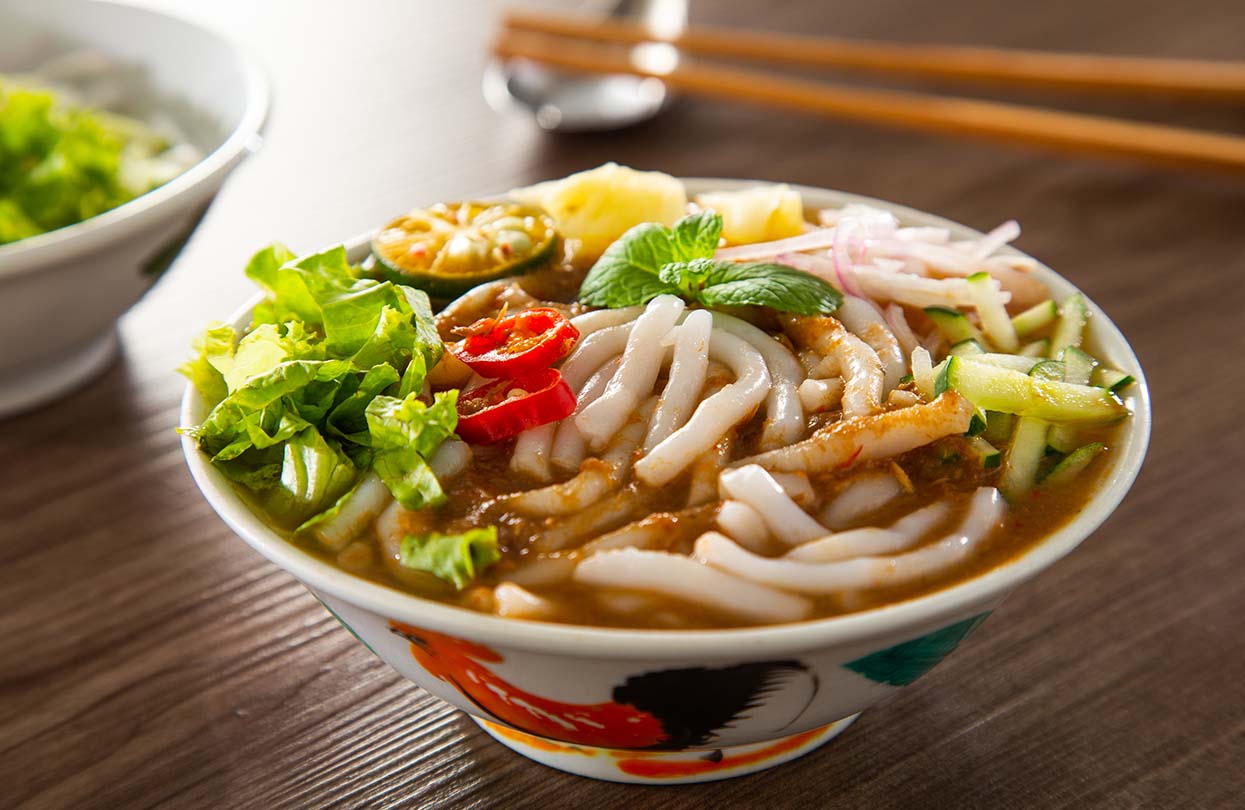
Assam Laksa, image by Bored Photography, shutterstock
George Town, Through a Luxurious Lens
UNESCO status gives George Town its architectural poise, but food grants it narrative. Start on Chulia Street and its tributaries, where enamel signs fade and steam curls from kopitiams. Then slip into restored salons where the same flavours arrive edited and framed: vintage porcelain, linen napery, a service tempo that respects the crunch-to-soft arc of a spoonful of jiu hu char.
In Pulau Tikus, markets hum with morning ferocity—heirloom herbs, hand-pounded rempah, turmeric leaves still damp from the hills. By lunch, nearby dining rooms translate those ingredients into plates with negative space and flawless temperatures. The pleasure is in the continuity: the auntie who grinds turmeric you’ll later taste as a satin smear beneath sea bass.
King Street carries another register—Hokkien cadence, clan houses, and alleyways where biscuits are baked in ovens older than our conversations about “authenticity.” Book a late seating in a heritage townhouse and the same street reads differently: candlelight catching shell-inlaid furniture, a lacquered tray of kuih designed to be eaten in silence.
Penang for the Curious Hedonist
I planned days as sequences rather than checklists—window-shopping for rempah in the morning, a noodle interlude, then a late tasting where familiar dishes revealed their skeletons. The luxury, for me, was access: a cook showing me how bunga kantan behaves when bruised rather than sliced; a sommelier pouring off-dry whites against sambal belacan to demonstrate balance; a pastry chef riffing on kuih lapis so the layers aligned with architectural precision.
Sustainability reads as elegance here. Resorts and high-end kitchens pull herbs from hill farms; fishermen arrive with line-caught prawns still tasting of tide. Vegan and halal paths are not afterthoughts but parallel lanes: jackfruit “rendang” with full rempah depth; tofu puffs that inhale curry like a compliment; coconut milk coaxed into satin without heaviness. Luxury, increasingly, is inclusion executed flawlessly.
Wine and Spirits? Penang plays well with both. Tamarind and torch ginger adore high-acid whites; coconut milk can flirt with Champagne; smoky sambals call for chilled reds that stay nimble. If you prefer local, artisanal tonic and tropical botanicals build intelligent gin cocktails that don’t bulldoze the food.
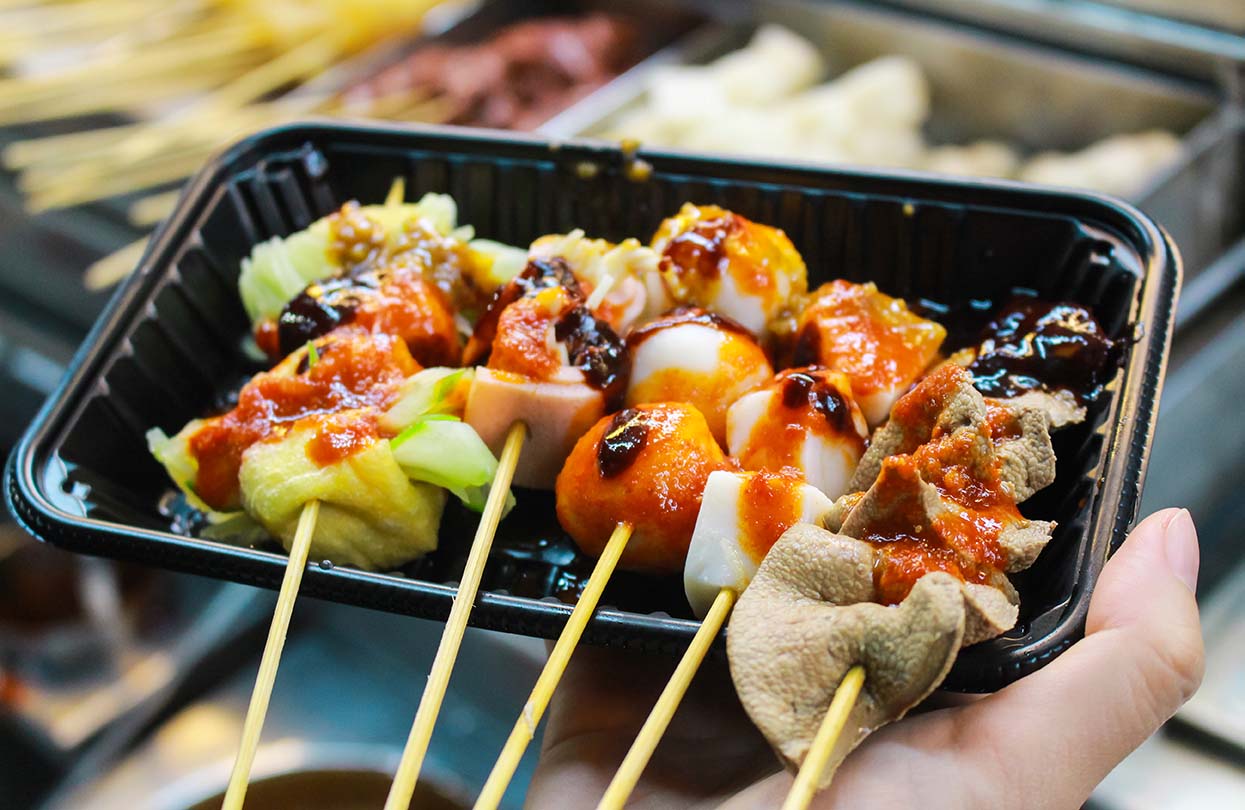
BBQ and Shabu-Shabu call Lok Lok, one of famous local outdoor dining in Penang, image by M Stocker, shutterstock
A Private Walk Through Heritage
To understand Nyonya cuisine is to sit close to the stove. In one shophouse kitchen, I watched turmeric stain a wooden pestle the color of marigolds. Candlenuts turned to cream under the weight of a stone mortar; shallots became music beneath the knife. Someone’s grandmother showed me how to judge a sambal with my ears—the sizzle’s pitch, not just the color. In the dining room, the same craft arrived disguised as ease: pongteh with its quiet depth of fermented bean paste, nasi ulam perfumed with so many herbs it read like a small forest on rice.
Luxury here isn’t the price tag. It’s the time. A rempah that took an hour of steady grinding; a curry monitored by smell rather than timer; a kuih layered and steamed in intervals that would test a saint’s patience. I felt honoured to eat what could so easily have been simplified and wasn’t.
From Hawker Lane to White Linen
There’s a romance to the hawker center at night—neon, smoke, a table that rocks, a plastic plate that holds the best thing you’ve eaten all week. There’s also a place for the quiet room, where the same idea is delivered like a sonata: measured, phrased, balanced against light and glass. In Penang’s higher registers, you might encounter:
Deconstructed assam laksa where the broth is a clear consommé poured tableside, and the aromatics—mint, bunga kantan, onion—arrive as micro-herbs and curls.
Nasi kandar “course-by-course”: one curry at a time across perfectly steamed rice, so the palate meets each spice blend without the customary riot.
Otak-otak amuse-bouches as a prelude, a banana-leaf-perfumed bite that announces the evening’s vocabulary.
If you need proof that heritage and haute can share a sentence, reserve a salon in a century-old mansion and watch a server set down a bowl of curry so beautiful you hesitate. Then don’t. Penang rewards appetite with insight.
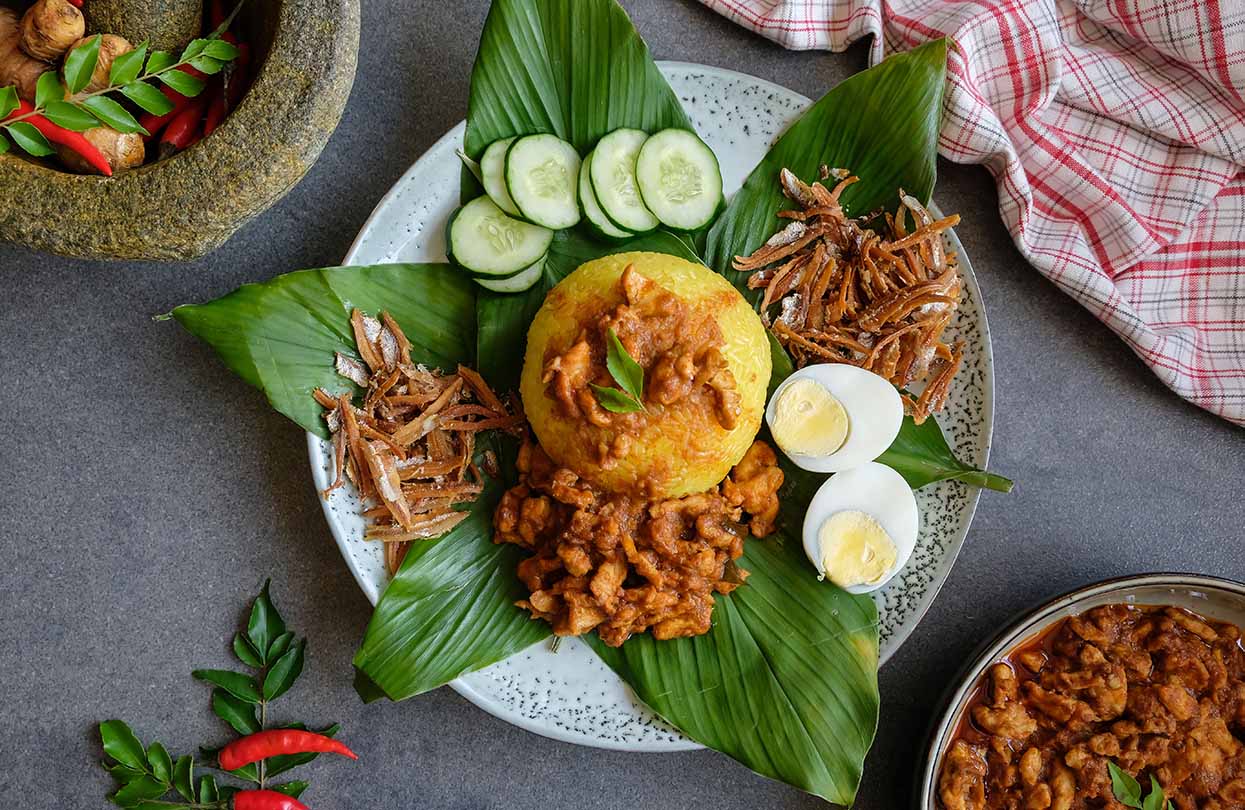
Traditional Malaysian Peranakan cuisine Nasi Kunyit aka Turmeric Glutinous Rice, image by YSK1, shutterstock
A Sensory Time-Travel
The island lets you dine like a port city person from 1880, hearing ships in your soup. On one night, nutmeg (once currency here) threaded through dessert in a custard that made sense of the whole meal. On another, a torch-ginger sorbet reset my palate so cleanly that I wanted the chef to teach a class on temperature.
Walk George Town after dinner. Lantern light on stucco, a bicycle bell somewhere near, sesame cookies cooling on a tray. This is luxury that doesn’t feel exported—it’s local poise, practiced for generations.
How to Eat Penang, Beautifully
Plan a progression: hawker lunch → curated tasting in a heritage room → late-night kuih and tea.
Book in advance for intimate salons and chef’s counters; specify dietary boundaries (vegan, halal) so rempah can be tuned with intent.
Pair intelligently: high-acid whites with laksa; Champagne with coconut-rich curries; light, chilled reds where smoke leads.
Go to market at dawn: watch herbs change name and colour in your notebook.
Leave room for a kuih flight: texture is a Penang love language—bouncy, chewy, silken, crisp.
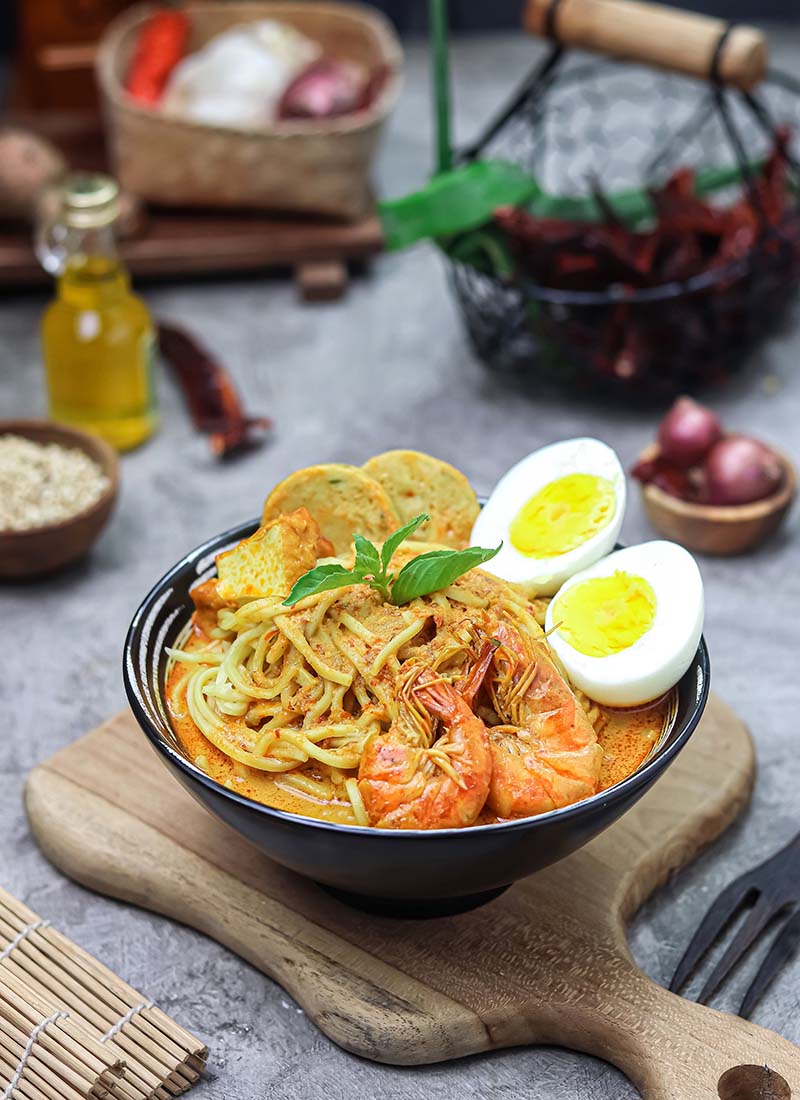
Curry Laksa, image by Ary Pranggawan, shutterstock
The Quiet Thesis of Penang
In a complicated world, Penang plates unity. Chinese noodles slip into Indian gravies; Malay herbs lift Chinese broths; Thai brightness kisses Hokkien char. It’s not fusion as fashion; it’s fusion as fact, lived long enough to have rules, manners, and extraordinary grace. For luxury travellers, that’s the invitation: taste history without stiffness, craft without pretence, and heritage with the dignity of white linen.
I left with spice under my nails and a new respect for precision. Penang taught me that the most luxurious meals aren’t the loud ones; they’re the ones that know exactly when to whisper.

Nyonya delights dessert “Kaya Kuih”, image by umitc, shutterstock
Practical Epilogue for Planners
Where to wander: George Town’s UNESCO core—Chulia, King, and the lanes around Armenian Street—for contrasts between kopitiam clatter and hush-toned dining rooms.
Neighbourhood to note: Pulau Tikus for morning markets leading to polished noon meals in nearby salons.
Signature tastes: assam laksa (tamarind, mackerel, mint, bunga kantan), nasi kandar (curries sequenced with intelligence), otak-otak (charcoal-scented custard), char kway teow (watch the wok, not your phone).
Sustainability cue: ask for hill-grown herbs and line-caught seafood; Penang does “eco-luxury” quietly and well.
Finish sweet: a curated kuih plate—blue pea tint, palm sugar depth, coconut snow—or nutmeg ice cream as a final nod to the island’s oldest economy.
See: Penang Best Whisky Tasting Masterclass & Bar Experience
Penang doesn’t perform luxury; it embodies it—through patience, ancestry, and the kind of flavour that reframes your week. If you’re ready to expand your taste buds with a style of cooking that refuses to be simple or showy, book the flight. Bring an appetite and a notebook. Leave space for wonder. ◼