Around seven, the air changes. You feel it first on the inside of the wrist, the way you feel the turning of a season, a coolness that has travelled across water and arrived smelling faintly of salt and diesel and the particular dust of stones that have been holding the sun all afternoon. This is the breeze off the Tagus, and it begins, in June, at almost the same hour each evening, as though the river were a household that keeps regular habits. The city receives it the way a body receives the loosening of a tight collar. Something gives.
You step out into Alfama. The alleys here are narrow enough that two people with shopping cannot pass without one turning sideways, and at this hour they are mostly empty, the day’s business folded away, the night’s not yet begun. A cat asleep on a doormat. A pair of trainers drying upside-down on a balcony railing. Somewhere overhead, a window has been left open, and from inside it comes a woman’s voice, not the practised vibrato of a fado house but the slower, less certain voice of someone working through a song alone in her kitchen, stopping to begin a phrase again, holding a note longer than the recording would. The voice is unaccompanied. She is not performing. She is just keeping company with something old.
The tiles. You think you know the tiles, you have seen them in books, on postcards, on the homepages of hotels, and you think you know that they are blue. But in June, at this hour, they are not blue. They are something between lavender and the inside of an oyster shell. The gold light moves across them like a hand, and the blue retreats, and what comes forward is a colour that has no name in any language you speak. A colour the makers of these tiles understood would only reveal itself once a day, for an hour, in a particular kind of weather. You stop in front of a wall in Largo de São Miguel and put your palm against it. The tile is cool. The grout is warm. The wall has been thinking all day, and now it is letting the thought go.
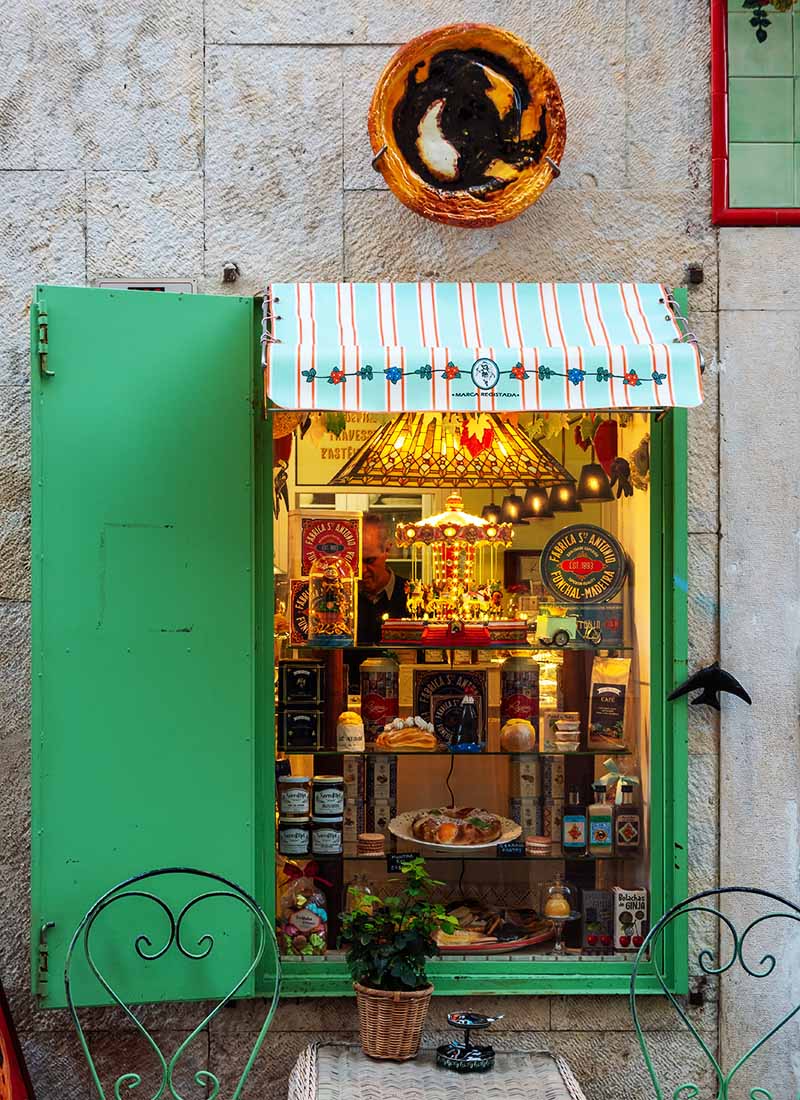
Storefront of Casa São Miguel, Image by Plam Petrov, Shutterstock
This is what photographers mean by Lisbon light. Not brightness — brightness is everywhere. This is a quality of softness, of low angle, of the sun having grown tired of itself, of the world being permitted, finally, to be the colour it always was underneath. It lasts perhaps two hours. It is the reason a certain kind of person crosses oceans.
You walk westward. The city is built on seven hills, and at this hour every walk in Lisbon eventually becomes a descent toward the river. You did not plan it. The streets simply tilt that way, and the body, grateful, follows. Climbing is for the morning. The evening is for going down.
Up through Príncipe Real, then, the long way around. The garden here is small, but in the centre of it stands a cedar of Lebanon planted in the eighteen-hundreds, its branches trained outward over a circular iron frame until the tree has become a low green roof, a parasol large enough to cover a small wedding. At its edges, couples sit on benches and do not speak. From the terrace of a bar across the road, a bar without a sign, which you would not have found if you had been looking, comes the sound of ice meeting glass. Someone laughs the laugh of a person whose first drink has done its work. The waiter passes carrying tall stems of green wine, condensation already running down the sides.
You could stop here. Many people do. There are evenings when the bar in Príncipe Real becomes the evening, and dinner is forgotten, and the cedar makes its slow shadow across the garden until the streetlights come on.
Tonight you keep walking. Downhill now in earnest, through streets that smell of grilled sardines and laundry detergent and the faint cigar-warmth of pavements giving back their heat. The Bairro Alto Hotel is somewhere above you. You stayed there last spring on assignment for World Travel Magazine and remember the way its terrace faces this exact direction at this exact hour, the rooftops below tessellating downward like a problem someone began to solve and then abandoned because the answer was already beautiful. You think of going back to it. You don’t. You keep walking.

View of the Tagus River at evening sunset from a hillside cobblestone street in the medieval Alfama district of Lisbon, image by Kirk Fisher, Shutterstock
At Cais do Sodré, you find the restaurant you were looking for, though you had not, until this moment, admitted you were looking for it. A terrace. Three tables. A view of the bridge, which at this hour has not yet begun to glow but is preparing to. The bread comes first. Then the wine, a vinho verde so cold the glass mists immediately. You tear the bread. You drink. You have not yet ordered, and there is no rush to order, because the city is doing the work of the first course on your behalf, offering you the breeze, the descent, the light, the bridge, the woman somewhere in Alfama who has now stopped singing and begun, perhaps, to cook her own dinner.
The light shifts from gold to a rose so faint you only notice it because the bridge begins to take on a colour it didn’t have a moment ago. You watch the bridge. You don’t look at your watch. You don’t take a photograph.
And then, without ceremony, without the great red performance other cities make of their endings, the gold becomes peach, and the peach becomes a grey so soft it is almost mauve, and the mauve loses its light by degrees so gradual that you cannot say at what minute the evening became the night. The waiter returns. He lights the candle on your table. You realise you have been sitting in the dark for some time, and that the lights of the city, mirrored on the river, have come on one by one without your noticing, and that the bridge is now a long necklace of small bright things, and that somewhere upstream, on a balcony, the same woman has begun to sing again, more quietly this time, to herself. ◼
Subscribe to the latest edition now by clicking here.
© This article was first published online in June 2026 – World Travel Magazine.